Apr 11, 2012

Portal, Tucson and Beyond: Easter Break '12

This past weekend (starting on April 5) I was in southeast Arizona with my dad for Easter Break. We birded in Portal, Bosque del Apache NWR, and hotspots near Tucson and saw 107 species of birds.
Bosque del Apache


We left Las Vegas, NM Thursday morning and worked our way down to Portal, stopping at Bosque del Apache NWR along the way. We saw a good 40 species at Bosque, including five species of swallows and a Surf Scoter (reported earlier that week). We got to our campsite (in Sunny Flat Campground) at around 10:30pm and quickly set up our tent and went to sleep.

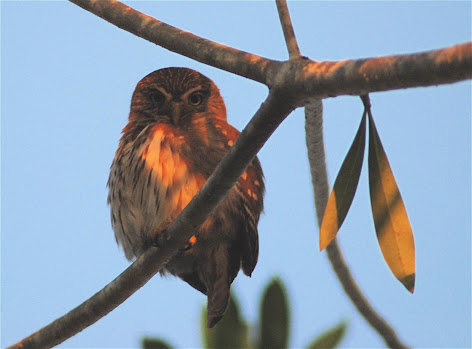
The next morning we got up relatively early (6:30am) and walked down South Fork (which was within a 1/4 mile of the campground). At first it was very quiet, but once the sun started hitting the trees (which took a while), the birds started to get much more active. We heard and saw many Painted Redstarts and Black-throated Gray Warblers and came across numerous flocks of Bridled Titmice and Mexican Jays. One of the highlights of the walk was a Dusky-capped Flycatcher (a new birds for the U.S. for me), which I first heard calling from an Arizona Sycamore. I was unfamiliar with the call at the time and only realized the identity of the bird once I looked it up back at the campsite. After birding South Fork for a few hours, we took a short nap and then got on our bikes and biked down to the Portal Store. There we saw some Inca Doves and numerous House Sparrows. On our way up to our campsite, we came across a Northern Pgymy-Owl, which apparently had gotten very indignant after my dad attempted to imitate its call (in an attempt to lure in a Dusky-capped Flycatcher that we we looking at). When I first heard the characteristic "TOO-TOO-TOO-TOO" I thought it was another birder trying to fool me. However, after listening to the call for a while, (and failing to see any humans in the proximity), I realized that it must be an actual pygmy-owl.  True enough, a roundish, small bird suddenly appeared in a tree above our heads. It was a pygmy-owl, alright. And it was still not very pleased with the intrusion of (seemingly), another pygmy-owl. It repeatedly called, until my dad I finally left in peace, but not before we managed to get dozens of close-up pictures.

Northern Pygmy-Owl


After getting back to the campsite, we headed down to Cave Creek Ranch and took pictures of various birds while sitting on a bench outside one the the buildings. Here are some of the pictures we took:

Northern Cardinal

Mating Curve-billed Thrashers

Curve-billed Thrasher

Blue-throated Hummingbird

White-breasted Nuthatch

Blue-throated Hummingbird

Scott's Oriole

Canyon Towhee
After birding around Portal and Cave Creek Canyon for two days, we headed to Tucson, where we stayed the remainder of our time, until our return home on April 9th. We birded Sweetwater Wetlands in Tucson (where we saw a roosting Great Horned Owl and a bathing Cooper's Hawk) and also went to Madera Canyon.

Orange-crowned Warbler

Sweetwater Wetlands

Great Horned Owl

Great Egret


Red-winged Blackbird

Northern Rough-winged Swallow

Cooper's Hawk
 

Mar 28, 2012

Black-and-white Warbler at my House!!!

Today I arrived home from school to find a Black-and-white Warbler sitting on a short stump right outside my window! What a nice surprise... It was my first for the year and certainly the first for my New Mexico list.


Dec 27, 2011

Christmas 2011


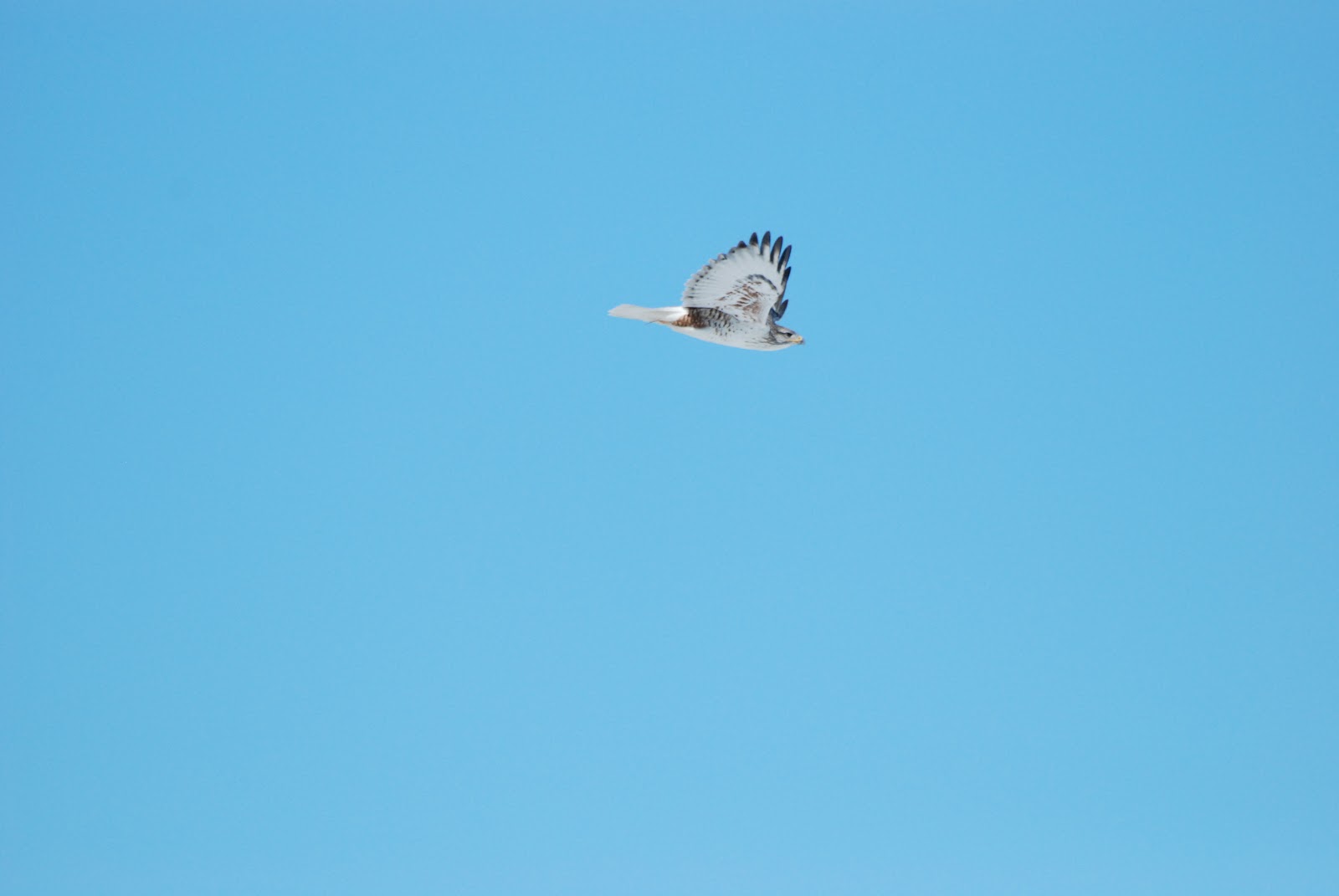
Adult Ferruginous Hawk


Adult Ferruginous Hawk


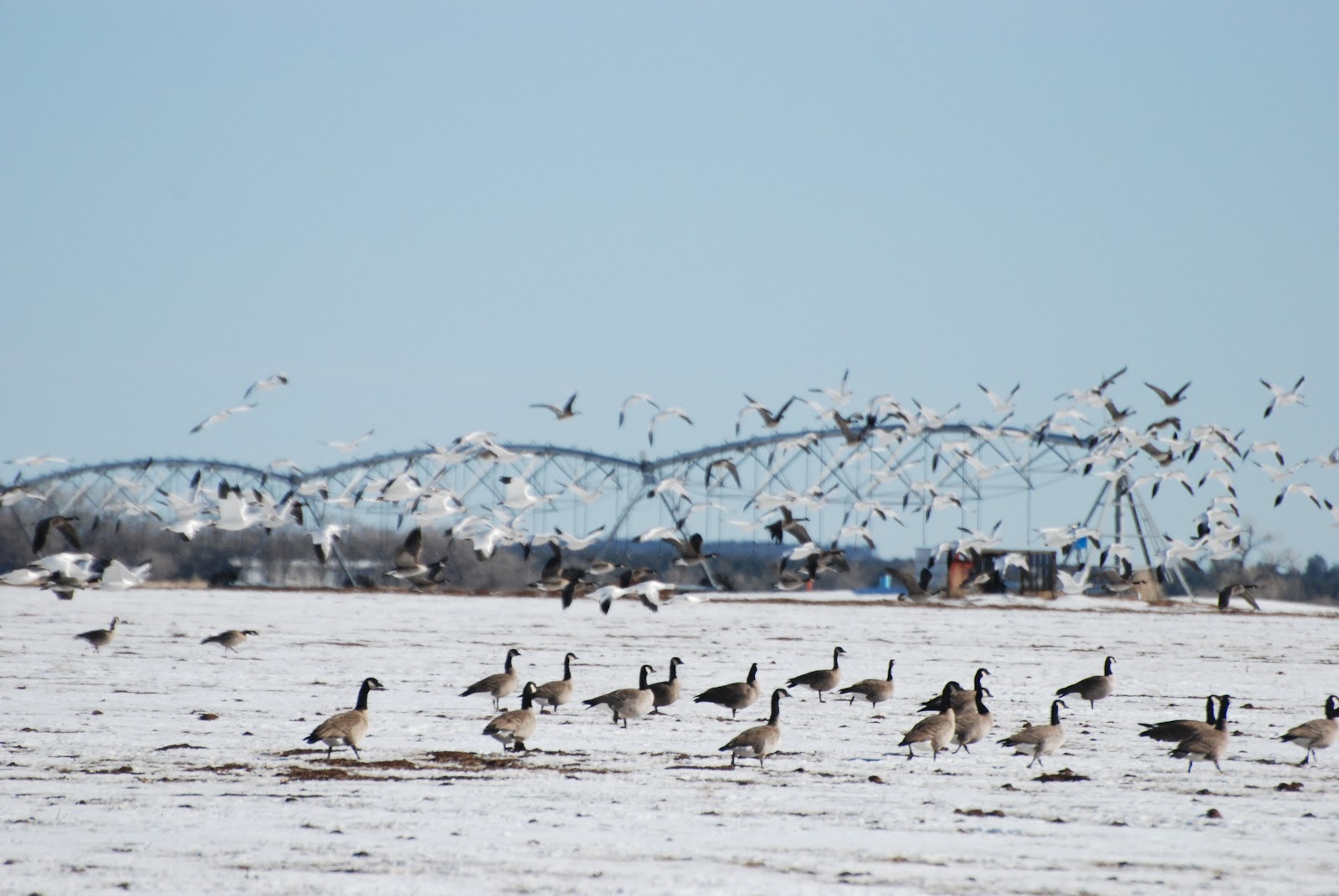
I had a very good Christmas this year with lots of family and friends and even got to go out birding a bit. I went to the Las Vegas NWR with some family on the 26th for the first time in weeks and I was very surprised by what I found. Most of the lakes were completely frozen over and all the waterfowl were in fields adjacent to the refuge loop road. There must have been about 800 geese, 400 ducks and 4 Bald Eagles. The only thing not present were cranes (which was very odd for this time of year).

I also saw a couple Ferruginous Hawks and managed to get some good pictures of one of them (see above). But I have to say, driving at 30 miles per hour while hanging a big camera out the window is a bit nerve-wracking!

Adult Ferruginous Hawk

Adult Ferruginous Hawk


Canada and Snow Geese


Nov 21, 2011

Festival of the Cranes and 1st Day of Rosy-Finch Banding!

This weekend I went down to Socorro to attend the Festival of the Cranes at the Bosque del Apache NWR with my dad. We had a great time and went to a couple of great presentations.

Snow Geese


On Friday night, after packing up everything in the car, we got on the road and we got to Socorro at 11:30pm. We ended up having to spend the night in the back of our Sequoia by some train tracks due to lack of inexpensive hotel rooms or a spot at the RV park. I never knew how comfy it could be sleeping in the back of a car; albeit it was a bit cramped but comfortable never the less. We only slept 4 hours that night and got up bright and early at 4:30am. We then drove to the Flight Deck at the refuge and watched the morning Fly-Off. To anyone who hasn't watched this: it is very spectacular and worth the yawns and the frozen fingers. We waited about an hour and a half before the geese and cranes decided it was time to get going and then the usual mad, synchronized takeoff took place. The Snow Geese all took off at about the same moment but the Sandhill Cranes didn't quite feel like that kind of show. They left in small groups of 3 to 4 for the next half hour (which of course took a lot longer than the geese). After watching the fly-off for couple minutes, we drove over to the visitor center and got some breakfast and lost some bills to the gift store (oh, the temptation of spending money).


The rest of the day we spent birding around the refuge and going to several talks. The first presentation was by my friends Raymond and Michael. They talked about the Rosy-Finch banding project they started about 5 to 6 years ago. It was a great presentation and it was also great to see Raymond and Michael again. Right after that talk we sped back out to the refuge to go looking for a Surf Scoter that was reported earlier in the morning. It took us a long time but we eventually found it on the far side of a pond, in amongst the reeds. It wasn't a good look, but I'm not complaining! It was my first for New Mexico, which got me very excited. After loitering around the refuge for a couple of hours we went to the Macey Center in Socorro for the big keynote presentation by Mark Obmascik. He was talking about The Big Year, his true story about three guys who take a year off from their normal life to chase birds. It was another great presentation and I got a lot of questions answered about the book (and the movie).

Me and my dad spent the night in Albuquerque at our friend Bill's house. The following morning we went up to Sandia Crest for the first day of Rosy-Finch banding. We picked up Greg Miller (one of the 3 guys who did the 1998 big year that's featured in the book) and then raced up to the Crest in order to get there on time. It was a bit slow for birds but I had a great time chatting and catching up with the banders. A couple Black Rosy-Finches came to the feeders and they banded a few and they also banded some Mountain Chickadees, and White-breasted and Red-breasted Nuthatches (because they're weren't many Rosy-Finches). My and I spent a couple hours up there and then we had to head back home. We spent a ridiculous amount of money at Costco and did a car wash and then finally got back to Las Vegas at 7:30pm.

Red-breasted Nuthatch

Black Rosy-Finch

Black Rosy-Finch
Black Rosy-Finch

Oct 8, 2011

My First Pelagic Trip!


I've gone 16 years without going on a pelagic trip and this past weekend I finally got the chance. I flew out to San Francisco on September 29th and my cousin Whitney picked my up at the airport. This wasn't my first California birding trip (I also birded with my cousin last March-I posted about that trip) but it certainly took the cake for the best birding experience I've had in quite a while.

The first night we stayed at a B&B in Point Reyes which was very nice and had a hot tub. The following morning we got up at 6:00am and birded the Pt. Reyes peninsula for the majority of the day. It was pretty foggy for the first part of the day but we saw a good chunk of birds. The best bird of the day were a couple Tricolored Blackbirds (also known as "Trikes") which were a life bird for me. We spent the whole day trying to pick out Trikes from flocks of Red-winged Blackbirds. It finally paid off though! We also saw 2 immature Great Horned Owls in a dead tree by the side of the road. One of them was making begging calls and Whitney and I ignored them at first because we thought they were blackbirds. Then I happened to glance over at the tree and noticed two rather large blobs. "Hey, they look like owls!" was my first remark. We walked across the road and sure enough, there were 2 very cute, young owls. They were past fledgling age but apparently still wanted to be fed by their parents.


One of the best parts of the day was meeting Peter Pyle at the Limontoyr (hope I spelled it right) Lighthouse. It was actually our first stop of the day and as we were walking back from the lighthouse we saw someone walking towards us in the fog. I knew it was probably a birder because who else would be tromping up to a lighthouse at 7:00 in the morning in pea-soup fog. I did not, however, expect to meet Peter Pyle. When he walked up, the first thing Whitney asked was if he was Peter Pyle. I probably resembled a stunned frog when she said those words and didn't quite believe her at first. But yes, I finally got to meet Peter Pyle at 7:00am on September 30th, at a lighthouse, in very dense fog. Peter Pyle was our best "bird" of the day until we saw the Trikes but I will certainly remember that meeting as one of the highlights of the trip. At the end of the first day, we had seen 65 species. It was a pretty good day considering that there was not very many birds out and the weather was less than ideal. We spent the night at Whitney's house in Redwood City and tried to go to bed early but failed miserably. We ended up hitting the sack at 11:00pm. Oops!

The second day we got up at 7:00am (which felt like sleeping in to me) and started the day by driving to the Skylawn Cemetery (on the way to Half Moon Bay). We saw 2 Red Crossbills fly over but other than that it was pretty quiet. After Skylawn, we birded around Half Moon Bay (including Pillar Point and Moss Beach). At Pillar Point we ran into an ABA tour group led by Alvaro Jaramillo just as they spotted a Wandering Tattler (which was a life bird for Whitney). We had pretty great looks at it and we also saw Surfbird, Black Turnstone, Black Oystercatcher, and Willet. Living in New Mexico, shorebirds are always very exciting. Whitney and I met the ABA group again at Moss Beach and were lucky enough to see a Baltimore Oriole along the trail. Someone in the group yelled out "ORIOLE!" and we all thought that he was pulling our legs until we saw the bird. It was a female and lacked the streaking on the face characteristic of Bulluck's Oriole. When Alvaro said it was a Baltimore, I didn't think much of it, because growing up in Massachusetts, these birds were regular. However, Baltimore Oriole is a pretty rare bird in California (especially in October).


By far, Sunday was the funnest. And that wasn't just because I saw 12 (yes 12!) life birds and went on my first ever pelagic trip (with Debi Shearwater and Peter Pyle mind you). As I mentioned before, I have never gotten the chance to go on a pelagic trip, although I've tried various times. This time was not in vain though! Naturally, the first time you're on a boat in the Pacific Ocean, you'll see a number of new birds. I was expecting to see maybe 4 to 5 lifers if I was lucky and what I ended up with was above and beyond anything I could have imagined. We started out the trip by getting to Pillar Point harbor at 7:00am sharp and got a briefing from Debi on the basic aspects of a pelagic trip and the general rule of not upchucking in the bow of the boat (the consequences from that can be rather gross). After everyone showed up, we pushed back from the dock and spent awhile looking for shorebirds along the jetty and saw a couple Surfbirds, oystercatchers, and a Clark's Grebe courting a Western Grebe (a hybrid in the making). We then worked our way out into Half Moon Bay and saw 2 Marbled Murrelets and a couple Common Loons. I kept my eyes open for big flocks of shearwaters but these were at a minimum. Going out of the harbor we did see some mixed flocks of murres and Sooty Shearwaters but the numbers were pretty low. I certainly wasn't complaining however. It took a total of about 10 minutes before I saw my first life bird-a Pink-footed Shearwater. I didn't get a great look at it but we ended up seeing much more of these during the course of the day. After the first Pink-footed Shearwater, I started seeing lifers left and right. Elegant Tern, Flesh-footed Shearwater, Cassin's Auklet, Pomarine Jaegar, Xantu's Murrelet, and Black-footed Albatross were just six of them. The density of birds for the day was low but the diversity was very impressive. My favorite bird were the Black-footed Albatrosses, which we got a few of. I've always been rather enamored with these majestic birds but this was the first time I had seen them with my own eyes.


Black-footed Albatross (sorry for the bad quality)

Pelagic trip group (Peter Pyle is center)

Ocean Sunfish (Mola Mola)
California Sea Lions

The Boat


On the way back to the harbor, I helped Peter Pyle and a few other staff do the bird list for the day. It felt very cool to be making a list with Peter Pyle and actually get some of the same figures! When he was asking me how many of a certain species I had seen, I would tend to make lower estimates, and when asked of his counts, he would go much higher. I have much more faith in Peter's ability to count accurately than my own and whenever he would offer a number, I would immediately agree with him. Plus, I always tend to make higher numbers lower when counting birds. We got back to the dock at 7:00pm and we were all very tired from an exciting, 12-hour day. I would certainly say that my first pelagic trip was a huge success.

 The list for all 3 days is below:


Canada Goose                    
Gadwall            
Mallard
Blue-winged Teal                    
Cinnamon Teal                    
Northern Shoveler                
Northern Pintail                
Green-winged Teal                    
Surf Scoter                    
Ruddy Duck            
California Quail                    
Wild Turkey                    
Common Loon                    
Pied-billed Grebe                
Horned Grebe
Eared Grebe                
Western Grebe                    
Clark's Grebe                
Black-footed Albatross                    
Northern Fulmar    
Pink-footed Shearwater                
Flesh-footed Shearwater                
Buller's Shearwater                
Sooty Shearwater    
Short-tailed Shearwater
Ashy Storm-Petrel            
Black Storm-Petrel            
Brandt's Cormorant                
Double-crested Cormorant                    
Pelagic Cormorant                
American White Pelican            
Brown Pelican                
Great Blue Heron                    
Great Egret                
Snowy Egret                    
Turkey Vulture                
Northern Harrier                    
Cooper's Hawk                
Red-shouldered Hawk                
Red-tailed Hawk                    
American Kestrel                                
Peregrine Falcon                
Virginia Rail            
Common Gallinule        
American Coot            
Black-bellied Plover                
Killdeer                
Black Oystercatcher                
Black-necked Stilt                    
American Avocet                
Wandering Tattler                
Greater Yellowlegs                
Willet                
Whimbrel                
Long-billed Curlew                    
Marbled Godwit            
Black Turnstone                    
Surfbird                
Sanderling                
Western Sandpiper                
Least Sandpiper                
Dunlin                
Red-necked Phalarope                
Red Phalarope            
Sabine's Gull            
Heermann's Gull            
Ring-billed Gull            
Western Gull        
California Gull                
Herring Gull                
Glaucous-winged Gull                
Common Tern                    
Arctic Tern                
Elegant Tern                
South Polar Skua                
Pomarine Jaeger                
Parasitic Jaeger            
Long-tailed Jaeger                    
jaeger sp.                    
Common Murre                
Pigeon Guillemot            
Marbled Murrelet                
Xantus's Murrelet            
Cassin's Auklet                
Rhinoceros Auklet            
Tufted Puffin                    
Rock Pigeon            
Eurasian Collared-Dove                
Great Horned Owl                
Anna's Hummingbird                
Belted Kingfisher                    
Acorn Woodpecker                
Downy Woodpecker            
Hairy Woodpecker            
Northern Flicker                
Black Phoebe                    
Say's Phoebe                
Loggerhead Shrike                
Steller's Jay                
Western Scrub-Jay            
Yellow-billed Magpie                
American Crow                
Common Raven                    
Barn Swallow            
Chestnut-backed Chickadee                    
Bushtit                
Pygmy Nuthatch                
Brown Creeper                    
Bewick's Wren                
House Wren                
Marsh Wren                
Wrentit                
Western Bluebird                    
American Robin                
European Starling                    
American Pipit        
Common Yellowthroat            
Yellow-rumped Warbler            
Townsend's Warbler        
Spotted Towhee            
Chipping Sparrow                    
Savannah Sparrow                
Song Sparrow                
Lincoln's Sparrow                
White-crowned Sparrow                    
Dark-eyed Junco                    
Red-winged Blackbird                    
Tricolored Blackbird                    
Western Meadowlark                    
Brewer's Blackbird                    
Brown-headed Cowbird                    
Baltimore Oriole                    
House Finch            
Red Crossbill                
American Goldfinch            
House Sparrow  

Aug 28, 2011

Dickcissels, Shorebirds and Mud

 I am terrible at identifying peeps and have been trying to distinguish those little buggers for the longest time and this weekend I finally had some progress in my identification of peeps.

Western Wood-Pewee at my house (nothing to do with peeps of course)


Christopher Rustay came down to Las Vegas on Saturday and met me at the Las Vegas Detention Center (yep, I spent the night in jail...just kidding) and I also got to meet a young birder from Santa Fe, along with his dad. Raymond and Bill (two birders from Albuquerque who I've birded with a bunch in the past couple years) also came down. We started by going to the Las Vegas NWR and birding a row of trees before the entrance to the refuge. It wasn't too productive but we saw a couple Wilson's Warblers, a Red-naped Sapsucker, and some MacGillavray's Warblers. After birding the stretch of trees for 20 minutes, we drove to the Headquarters. There are a row of trees near the road that can be good during migration in front of the HQ building. We walked along this and found a resting Barn Owl and a Cooper's Hawk (that was mobbing the Barn Owl). We also saw a Willow Flycatcher (my first for New Mexico) and heard 2 Upland Sandpipers.

The next stop was Crane Lake, just a 3 minute drive from Headquarters. We scoped the lake and found 2 American White Pelicans, 50+ Cinnamon Teal, 2 White-faced Ibis, and Peregrine AND Prairie Falcon. The Peregrine was on a big dead tree besides the lake and while we were looking at it a Prairie flew over our heads! There were also a couple peeps on the mud surrounding the lake. My first thought was "oh crap, what are these?" Luckily, I was with 5 birders who had a much larger knowledge of peep identification than I did. They showed me a group of peeps with tan throats and scalloped backs and pronounced them to be Baird's Sandpipers. I was very excited to finally find out what those "tiny things with tan throats" were and was feeling a bit more confident. Unfortunately, that was only one species and I have much more to learn before I master peeps. I was certainly a big help though. Thanks guys!

On McAlister Lake, there was another group of Baird's Sandpipers with about 850 Wilson's Phalaropes swimming on the lake! I had never seen that many phalaropes before-you could probably have walked across the lake on them! Besides the concentration of phalaropes, there wasn't much around or on the lake. We saw a Long-billed Curlew fly over and saw some more Willow Flycatchers but that was about it.

After birding the refuge for 3 hours, we headed out and drove to Springer Lake (about 1 hour north from Las Vegas). Talk about shorebirds! On the nearest side of the lake to the road there was barely anything but when we walked to the other side, there was a huge flock of mixed peeps, dowitchers, yellowlegs, plovers, and phalaropes. I got very excited at the sight of so many peeps and we decided to walk out on the mudflat a bit. We got pretty great views of Baird's, Western, and one Semipalmated Sandpiper along with some Lesser Yellowlegs, Wilson's Phalaropes, and Long-billed Dowitchers. The best bird was a lone juvenile Short-billed Dowitcher that Raymond picked out from a flock of Long-billeds. We were all hyped by this discovery (especially Christopher) and each of us got great looks at the bird in our scopes. Raymond tried to walk closer to the bird with his camera to take a picture and I decided to follow him. This was probably a mistake. As we walked farther towards the lake, it got harder to not sink into the mud. Raymond was a pro at keeping his shoes clean (and with a scope and camera) but I was pretty much a failure. I failed to learn that you have to walk with a broad stance and with light footsteps and consequently sunk knee-deep in the mud with my clumsy footsteps. I watched Raymond's many attempts at digiscoping the Short-billed Dowticher-which he eventually did get a great picture of-and tried not to say anything as my legs slowly oozed deeper into the mud. When Ray finally got a suitable picture of the bird, he turned to me and was surprised to see that I was now 2 feet shorter than him. He shook his head and laughed and helped me get out of my predicament by having me hold onto the scope and his hand. I eventually got out (after much tugging and squelching) and tramped back to the car with my shoes looking like they had just been stuck down a mud hole...never mind, that actually happened! I tried to remove as much of the mud as I could but I was still covered up to my knees for the rest of the day.

With me covered in mud, we stopped at a Subway to eat lunch and for me to try and clean up some more. I probably used Subway's entire stock of paper towels and still looked like crap. Oh well. Lunch was a relief though-nothing like eating Subway after half-sinking yourself in a mudflat!

We stopped at Maxwell NWR after lunch and I saw my life Dickcissel! We were near the entrance and saw a bird fly across the road and land on a fence and were very surprised to find out it was a Dickcissel (or DICK in its 4-letter code). It also happened to be #650 on my life list! Besides the DICK, we didn't see much (a couple American Avocets and a Peregrine Falcon were the exception).

The last stop of the day was Stubblefield Lake. It is just a short drive from Maxwell and can be very good for shorebirds sometimes. Unfortunately, there were very little shorebirds or waterfowl. Christopher did find a Common Loon as we were leaving, which is a pretty good bird for northern New Mexico.

Overall, it was a very fun and productive day and we ended up seeing 74 species. Below is the species list for the day:


Canada Goose -- 50
Mallard -- 1
Cinnamon Teal -- 80
Northern Shoveler -- 10
Green-winged Teal -- 20
Ruddy Duck -- 200
Common Loon -- 1
Eared Grebe -- 7
Clark's Grebe -- 2
Double-crested Cormorant -- 14
American White Pelican -- 3
Great Blue Heron -- 10
White-faced Ibis -- 16
Turkey Vulture -- 7
Northern Harrier -- 1
Cooper's Hawk -- 1
Swainson's Hawk -- 5
Red-tailed Hawk -- 1
Peregrine Falcon -- 1
Prairie Falcon -- 1
American Coot -- 50
Semipalmated Plover -- 2
Killdeer -- 10
American Avocet -- 5
Spotted Sandpiper -- 4
Solitary Sandpiper -- 2
Lesser Yellowlegs -- 3
Upland Sandpiper -- 2
Long-billed Curlew -- 1
Semipalmated Sandpiper -- 1
Western Sandpiper -- 4
Baird's Sandpiper -- 200
Short-billed Dowitcher -- 1
Long-billed Dowitcher -- 4
Wilson's Phalarope -- 850
Ring-billed Gull -- 10
Forster's Tern -- 1
Rock Pigeon -- 1
Eurasian Collared-Dove -- 4
White-winged Dove -- 1
Mourning Dove -- 9
Barn Owl -- 1
Black-chinned Hummingbird -- 2
Red-naped Sapsucker -- 1
Western Wood-Pewee -- 3
Willow Flycatcher -- 4
Say's Phoebe -- 1
Cassin's Kingbird -- 1
Western Kingbird -- 5
Loggerhead Shrike -- 1
Common Raven -- 3
Horned Lark -- 15
Violet-green Swallow -- 5
Barn Swallow -- 5
Bewick's Wren -- 1
House Wren -- 1
Northern Mockingbird -- 1
European Starling -- 40
MacGillivray's Warbler -- 2
Yellow Warbler -- 10
Wilson's Warbler -- 2
Chipping Sparrow -- 4
Brewer's Sparrow -- 2
Vesper Sparrow -- 2
Lark Sparrow -- 3
Lark Bunting -- 1
Dickcissel -- 1
Red-winged Blackbird -- 18
Western Meadowlark -- 2
Yellow-headed Blackbird -- 4
Bullock's Oriole -- 1
Pine Siskin -- 7
Lesser Goldfinch -- 10

Unfortunately, I forgot a camera (again) and don't have any pictures. I'm going to start bringing a camera on all my birding trips so this doesn't happen again!

Aug 20, 2011

Cornell Lab's Young Birders Event 2011

I just got back from Ithaca, New York, where I went to a fabulous 4-day event at the Cornell Lab of Ornithology geared towards young birders. It wasn't my first experience with events for young people interested in birds. Last summer I participated in the Coastal Maine Bird Studies for Teens (which I wrote about in a previous post) which was fantastic and very inspiring. This experience was no different.


I flew out to Ithaca on August 10th and the event began at 2:00pm on the 11th. It started with a general tour of the Lab and we got to see sound and video recording studios, a small part of the bird collection, and other very cool stuff. There were 9 other teen birders in attendance who were from various parts of the U.S. and in one case, Mexico. It was great to be around people my own age who were as passionate about birds as me. Every day we would get up at around 5:00am (unless someone slept through their alarm) and have a quick breakfast. At six, we'd get picked up at the Golondrinas House (the place we were staying) by the instructors and we'd head out in a van to go birding. The van seated 12 people and everything fit pretty well (expect the far back seat was rather squished with 4 people). Some of the birding spots we went to were Myer's Point, Montezuma NWR, Hammond Hill, and the Roy H. Park Preserve. These are all birding hot spots within driving distance of Ithaca. I think we ended up seeing about 100 species and there were a couple life birds for several of us. My only new bird was a Yellow-billed Cuckoo which we saw by the side of the road in a big stand of oaks. It had been awhile since I'd had my last lifer (it seems like it gets a lot harder to see new birds the longer you are actively birding). We also saw a number of warblers (Cerulean, Blackburnian, Prairie, Black-throated Blue, ect). I had never birded in New York before so this was a new experience for me.

Besides from birding, we also got to use recording equipment from the Lab and experiment with some sound recording. There were lots of very inspiring talks by very inspiring people and the camp was worthwhile just because of them. Most of the speakers talked about their time at the Lab and what they did to volunteer or work. Numerous different internship opportunities were mentioned, along with ways that you could help the Lab with their research. Hearing someone talk about collecting and banding birds in highland Peru is one of the most inspiring things, as is listening to someone recall the process of making a field guide to subtropical birds. The amount of opportunities for interns at the Lab is amazing. Plus, all of the staff are extremely helpful and willing to listen to any crazy idea that you brew up.

To get to and from this camp it took more than 12 hours of traveling (including an overnight drive to get on my plane ride back home) but it was all worth it. I'd like to give a HUGE thank you to Pete Feitner, who drove me those 12 hours and was amazing. If you're reading this Pete, thanks a bunch!

Besides from just being really fun, this camp gave me lots of ideas about career possibilities in ornithology, cool internships, and inspiration in general to do more for our planet. To any young birders out there: I would certainly invest in taking this camp!!

Sorry for the lack of pictures in this post. I forgot to take my camera along with me (big mistake) and thus, didn't take any pictures!

Aug 18, 2011

My First Breeding Bird Survey!


June 2011    

     Today I helped do a Breeding Bird Survey (BBS) on a route near my house. I was only the assistant and did the recording. In case people are unaware of what a Breeding Bird Survey is, I'll explain. A BBS is a yearly census of breeding birds, conducted all over North America and in different parts of the world. There are numerous BBS routes across the country which people cover every year. Normally one to two people conduct the survey and it is done within a certain time frame. Every route has its own starting time, which remains the same every year. The criteria for counting is to stop every .5 miles and write down all the birds that the observer hears or sees. There is a limit of 3 minutes to stay at one "point" and then you must move on to the next point. There are usually 50 points along any given route.

     On the route I helped with there was 50 points and it covered about 20 miles. I woke up at 3:30am and met my friend, Christopher, at his hotel. We drove to the start of the route and did the first point at exactly 5:16am (the required starting time). We worked our way up into the mountains behind Las Vegas and continued until we came into town (on a map it resembled a big circle). There were some interesting birds during the survey, including a Northern Pygmy-Owl we heard at the start of the survey, Gray and Hammond's Flycatchers, Gray Catbird, Cassin's Kingbird, and Grace's and Virginia's Warblers.

Mar 19, 2011

Just Some Pics

Partially-albino Dark-eyed Junco

A Killdeer at my Feeder!

My sister's pregnant mare

My dog Zia

Home in New Mexico!

Home in New Mexico!
Las Vegas

Common Black Hawk

Common Black Hawk
Rio Lagartos, Yucatan

Ferruginous Pygmy-Owl

Ferruginous Pygmy-Owl
Bacalar

Pale-billed Woodpecker

Pale-billed Woodpecker
Kalakmul ruins

Dark-eyed Junco

Dark-eyed Junco
Home

Red-tailed Hawk

Red-tailed Hawk
In my backyard-Las Vegas,NM

Me on Hermit's Peak

Me on Hermit's Peak
Las Vegas, New Mexico

Zia Being Cute

Zia Being Cute
Home