We are back in the US of A and having to deal with cultural shock! I mean, there two very different countries and with two very different cultures. In the states you can't watch El Superbowl in Spanish or go to the zocalo and have 10 limonada minerals and in Mexíco you can't watch the Red Sox on NESN or the Diomondbacks on FSN!
Well, overall I'm a little shocked about the different cultures but am glad to be back where I can see Elegant Trogons and Flammulated Owls. Our border crossing was extremely quick, it only took 10 minutes! After crossing we drove to Del Rio and stayed at a campground with internet (wow!) and then the next day popped down and went to the Historic Prude Guest Ranch (for short Prude Ranch or HPGR) and stayed there for 4 days and did lots of fun stuff. Teslin rode with mom on a 45 minute ride (was spose to be longer) and the four of us did a half-day ride from Fort Davis Stables, about 10 minutes away from the Prude Ranch. That ride was pretty fun and I saw a lifer, Scaled Quail but afterwards I felt like I was sitting on a pointed rock for days (finally its better) and didn’t like that i couldn’t play b-ball or tennis!
During the 4 nights we were there I saw a family of Elf Owls (a lifer for me) nesting in a phone poll near our pop-up and every night I dragged myself out of bed and went to see the cute litttle owls! After 4 nights at the Prude Ranch we made for Tucson and got there the same day we left the Prude Ranch.
Now we are staying at Milagro Co-housing for a couple of weeks (at first we stayed at my aunt and uncles place). We have settled in and got a hummer feeder and a thistle bag and thistle seeds. We now have lots of hummers feeding and drinking out of the founting but the finches haven’t found the thistle yet. I was invited to a meal with two other young birders (a 9 and 13 year old) by a volonteer at the Tucson Audobon Society on May 31. I’m pretty excited for that and for meeting other youngsters like me who our into birding! I think the TAS just finished their yearly Birdathone and the meal is in that honor.
Yesterday we went to the Pualo Frier Freedom School to check it out and see if we want to go there or not and we liked it a lot! It was a little crazy though.
May 23, 2008


May 6, 2008
Terns at every Turn 5/2/08
Today we went to Rio Lagartos and went on one of the boats that tours provide with a guide that really knew his birds. I ended up seeing 7 lifers and 49 species overall. Here is how it all turned out.
6:45AM: I grudgingly got out of bed, had a quick breakfast (cereal), and got ready to go.
7:45AM: We got in the car and headed for Rio Lagartos (listening to Harry Potter and the Deathly Hallows as dad drove).
9:15AM: We arrived at RL and looked for a good boat launch.
9:30AM: We found a good bird guide (named Eddie) to drive the boat and headed out into the rio.
9:30-1:00PM: We wove through mangroves and I saw 4 species of terns, Sandwich, Royal, Gull-billed, and the beautiful Black Skimmer (all of these being lifers for me). Terns were everywhere! At one place there was Caspian and Royal flying together and a Gull-billed and Sandwich on a sandbar! The Black Skimmers I saw where on a dock mixed with Laughing Gulls and a Sandwich [Tern]. I also saw my first Laughing Falcon perched right next to the waters edge! It looked at us for a while and then took off when we got too close. The Greater Flamingos were pretty fun to watch and I saw 2 Western Sandpipers (my first ones). Our guide taught me how to identify Westerns from Least (there very similar). Western Sandpipers have black legs while Least have paler legs. Also, in breeding plumage Western has some reddish blotches on its head and other parts of its body.
Aside from those 7 life birds and the 49 species I saw, I didn’t see that much. I was aiming for 30 so I guess I passed that mark. I heard a Mangrove Vireo but couldn’t find it. Here is the whole list from Rio Lagartos:
Bird List for Rio Lagartos
1. Sandwich Tern*new
2. Black Skimmer*new
3. Magnificent Frigatebird
4. Brown Pelican
5. Laughing Gull
6. Black Vulture
7. Lineated Woodpecker
8. Barn Swallow
9. Bare-throated Tiger-Heron
10. Turkey Vulture
11. Double-crested Cormorant
12. Snowy Egret
13. White-winged Dove
14. White Ibis
15. Reddish Egret
16. Wood Stork
17. Yellow Warbler
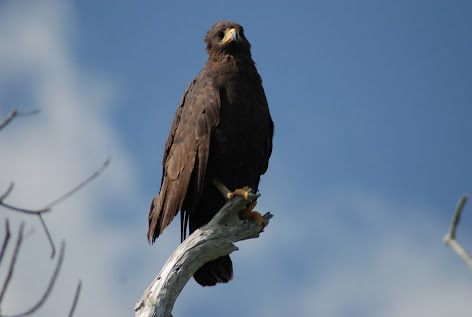
18. Common Black-Hawk
19. Great Egret
20. Great Blue Heron
21. Golden-fronted Woodpecker
22. Tropical Kingbird
23. Osprey
24. Tropical Mockingbird
25. Laughing Falcon*new
26. Spotted Sandpiper
27. Little Blue Heron-White Morph
28. Boat-billed Heron
29. Anhinga
30. Tricolored Heron
31. Common Ground-Dove
32. Least Tern
33. Greater Flamingo*new
34. American White Pelican
35. Western Sandpiper*new
36. Least Sandpiper
37. Caspian Tern
38. Royal Tern*new
39. Gull-billed Tern*new
40. Bobolink
41. Dunlin
42. Savannah Sparrow
43. American Avocet
44. Black-necked Stilt
45. Roseate Spoonbill
46. Long-billed Dowitcher
47. Mangrove Vireo (heard)
48. Cattle Egret
49. Common Moorhen
List of Tern Species I saw in Rio Lagartos
1. Black Skimmer
2. Caspian Tern
3. Gull-billed Tern
4. Least Tern
5. Royal Tern
6. Sandwich Tern
6:45AM: I grudgingly got out of bed, had a quick breakfast (cereal), and got ready to go.
7:45AM: We got in the car and headed for Rio Lagartos (listening to Harry Potter and the Deathly Hallows as dad drove).
9:15AM: We arrived at RL and looked for a good boat launch.
9:30AM: We found a good bird guide (named Eddie) to drive the boat and headed out into the rio.
9:30-1:00PM: We wove through mangroves and I saw 4 species of terns, Sandwich, Royal, Gull-billed, and the beautiful Black Skimmer (all of these being lifers for me). Terns were everywhere! At one place there was Caspian and Royal flying together and a Gull-billed and Sandwich on a sandbar! The Black Skimmers I saw where on a dock mixed with Laughing Gulls and a Sandwich [Tern]. I also saw my first Laughing Falcon perched right next to the waters edge! It looked at us for a while and then took off when we got too close. The Greater Flamingos were pretty fun to watch and I saw 2 Western Sandpipers (my first ones). Our guide taught me how to identify Westerns from Least (there very similar). Western Sandpipers have black legs while Least have paler legs. Also, in breeding plumage Western has some reddish blotches on its head and other parts of its body.
Aside from those 7 life birds and the 49 species I saw, I didn’t see that much. I was aiming for 30 so I guess I passed that mark. I heard a Mangrove Vireo but couldn’t find it. Here is the whole list from Rio Lagartos:
Bird List for Rio Lagartos
1. Sandwich Tern*new
2. Black Skimmer*new
3. Magnificent Frigatebird
4. Brown Pelican
5. Laughing Gull
6. Black Vulture
7. Lineated Woodpecker
8. Barn Swallow
9. Bare-throated Tiger-Heron
10. Turkey Vulture
11. Double-crested Cormorant
12. Snowy Egret
13. White-winged Dove
14. White Ibis
15. Reddish Egret
16. Wood Stork
17. Yellow Warbler
18. Common Black-Hawk
19. Great Egret
20. Great Blue Heron
21. Golden-fronted Woodpecker
22. Tropical Kingbird
23. Osprey
24. Tropical Mockingbird
25. Laughing Falcon*new
26. Spotted Sandpiper
27. Little Blue Heron-White Morph
28. Boat-billed Heron
29. Anhinga
30. Tricolored Heron
31. Common Ground-Dove
32. Least Tern
33. Greater Flamingo*new
34. American White Pelican
35. Western Sandpiper*new
36. Least Sandpiper
37. Caspian Tern
38. Royal Tern*new
39. Gull-billed Tern*new
40. Bobolink
41. Dunlin
42. Savannah Sparrow
43. American Avocet
44. Black-necked Stilt
45. Roseate Spoonbill
46. Long-billed Dowitcher
47. Mangrove Vireo (heard)
48. Cattle Egret
49. Common Moorhen
List of Tern Species I saw in Rio Lagartos
1. Black Skimmer
2. Caspian Tern
3. Gull-billed Tern
4. Least Tern
5. Royal Tern
6. Sandwich Tern
Apr 19, 2008
Resplendent Quetzal Report
Description
Resplendent Quetzals are one of the world’s most gorgeous birds. I have never seen one myself, but I’ve heard of how beautiful they are. Males have a red breast, green body, bluish back and very long, green tail streamers. They also have a yellow beak, which is fairly small (the females have black beaks). Males are 39 inches in length, including their plumes or streamers. Females have much shorter plumes (just extending right below the tail) and are drabber in color. The “song” is like “a whimpering pup” or as kyow or vi-viu, which is sometimes repeated monotonously. They have other unmusical calls too.
Range and Habitat
“Resplendents”, as I call them, are found from southern Mexico to western Panama. There is also a subspecies found in Costa Rica, P.m. costaricensis. The population in southern Mexico (Pharomachrus mocinno) is found only in Chiapas in remote montane cloud forests called “bosques de niebla”. The “bosques de niebla” are dense and wet and have mixed trees including pines. One of the quetzal’s favorite trees is the tepeaguacate tree, which has small avocados that the quetzals like to eat (see diet).
Diet
Resplendent Quetzals eat mainly fruit; their favorites are the wild avocados from the tepeaguacate trees. They also like fruit from the trees of the Laurel family. The birds swallow the fruit whole and then regurgitate the pits, which helps to increase the population of these trees.
Resplendent Quetzals are weak fliers and they have some predators. These include the Ornate Hawk-Eagle, owls, and Kinkajou, which hunt the birds themselves. Emerald Toucanets, (yes, little toucans) and squirrels, eat the eggs of the quetzals when the nest is left unguarded.
Breeding
Resplendents usually start calling and looking for mates in February. They start nesting a little bit after they call and mate. The female chooses a suitable tree for nesting (mostly rotting tree stumps) and then the pair pecks out a good-sized hole for the nest. Then the female lays 2 pale blue eggs and starts incubating them. The male and female share incubating: the male sits on them in the daytime while the female incubates at night. The incubation period lasts 18 days while the pair keep switching off incubating. When the male is sitting on the eggs, his long tail hangs out of the nest-hole so that from a distance it looks like a green fern is growing out of the hole! When 18 days are up, two little quetzal babies pop their heads out of their shells and say “give me some grub, mom”! Both parents take care of the little youngsters and feed them their grub, which includes fruit, berries, insects, and some frogs and lizards (big grub). Here is when it gets interesting. Near the end of the rearing period the female gets sooooo fed up with her little furballs that she says “vaya con dios you little scraps”, and leaves the dad to finish rearing the young until they are ready to fend for themselves!
Myth and Legend
Resplendent Quetzals play a big role in Mayan and Aztec legend and myth. The Mayans and Aztecs viewed the quetzal as the “god of the air” and as a symbol of goodness and light. Mesoamerican rulers wore headdresses made from quetzal feathers that symbolically connected them to Quetzalcoatl. Quetzalcoatl was the god of wind and the creator god. It was a crime to kill a quetzal so people simply captured and plucked its tail streamers and then released the bird. The tail feathers supposedly grew back in time. Ohh, I forgot. Mesoamerica was a region of Central America and South America that was inhabited by the Mayans and several other pre-Columbian civilizations.
The Resplendent Quetzal is Guatemala’s national bird and the quetzal is on their flag and coat of arms. The bird is also on the paper money and of great relevance in the country. It is mentioned in the widely popular legend of Tecún Umán, a prince/warrior of the Quiche Maya. The legend is that when the conquistador, Pedro de Alvarado, fought against Tecún Umán, there was a quetzal flying above the fight. Pedro de Alvarado managed to disable Tecún Umán’s horse and then killed him. Then, the quetzal flew down to Tecún’s chest and dipped its chest in the warrior’s blood. It was there that the quetzal acquired its gorgeous red chest feathers.
Conservation
Resplendent Quetzals are as Wikipedia states “near threatened”. They are not on the Endangered Species List but they might be on it in the near future. The population in Guatemala and southern Mexico is most threatened due to loss of habitat and hunting for their feathers. Costa Rica’s population of quetzals is in better shape because Costa Rica is setting aside some forest for quetzals and other wildlife.
I wrote this article so I could learn more about quetzals and help the species. I traveled through the quetzal’s forest in southern Chiapas and never saw one but I’m glad I at least know a little bit about them.
References:
1. Resplendent Quetzal, by Wikipedia, the free encyclopedia
2. El Quetzal, by Miguel Limón Rojas, Edmundo Salas Garza
3. A Guide to the Birds of Mexico and Northern Central America, by Steve N.G. Howell and Sophie Webb
4. The Resplendent Quetzal, by TED Case Studies
Resplendent Quetzals are one of the world’s most gorgeous birds. I have never seen one myself, but I’ve heard of how beautiful they are. Males have a red breast, green body, bluish back and very long, green tail streamers. They also have a yellow beak, which is fairly small (the females have black beaks). Males are 39 inches in length, including their plumes or streamers. Females have much shorter plumes (just extending right below the tail) and are drabber in color. The “song” is like “a whimpering pup” or as kyow or vi-viu, which is sometimes repeated monotonously. They have other unmusical calls too.
Range and Habitat
“Resplendents”, as I call them, are found from southern Mexico to western Panama. There is also a subspecies found in Costa Rica, P.m. costaricensis. The population in southern Mexico (Pharomachrus mocinno) is found only in Chiapas in remote montane cloud forests called “bosques de niebla”. The “bosques de niebla” are dense and wet and have mixed trees including pines. One of the quetzal’s favorite trees is the tepeaguacate tree, which has small avocados that the quetzals like to eat (see diet).
Diet
Resplendent Quetzals eat mainly fruit; their favorites are the wild avocados from the tepeaguacate trees. They also like fruit from the trees of the Laurel family. The birds swallow the fruit whole and then regurgitate the pits, which helps to increase the population of these trees.
Resplendent Quetzals are weak fliers and they have some predators. These include the Ornate Hawk-Eagle, owls, and Kinkajou, which hunt the birds themselves. Emerald Toucanets, (yes, little toucans) and squirrels, eat the eggs of the quetzals when the nest is left unguarded.
Breeding
Resplendents usually start calling and looking for mates in February. They start nesting a little bit after they call and mate. The female chooses a suitable tree for nesting (mostly rotting tree stumps) and then the pair pecks out a good-sized hole for the nest. Then the female lays 2 pale blue eggs and starts incubating them. The male and female share incubating: the male sits on them in the daytime while the female incubates at night. The incubation period lasts 18 days while the pair keep switching off incubating. When the male is sitting on the eggs, his long tail hangs out of the nest-hole so that from a distance it looks like a green fern is growing out of the hole! When 18 days are up, two little quetzal babies pop their heads out of their shells and say “give me some grub, mom”! Both parents take care of the little youngsters and feed them their grub, which includes fruit, berries, insects, and some frogs and lizards (big grub). Here is when it gets interesting. Near the end of the rearing period the female gets sooooo fed up with her little furballs that she says “vaya con dios you little scraps”, and leaves the dad to finish rearing the young until they are ready to fend for themselves!
Myth and Legend
Resplendent Quetzals play a big role in Mayan and Aztec legend and myth. The Mayans and Aztecs viewed the quetzal as the “god of the air” and as a symbol of goodness and light. Mesoamerican rulers wore headdresses made from quetzal feathers that symbolically connected them to Quetzalcoatl. Quetzalcoatl was the god of wind and the creator god. It was a crime to kill a quetzal so people simply captured and plucked its tail streamers and then released the bird. The tail feathers supposedly grew back in time. Ohh, I forgot. Mesoamerica was a region of Central America and South America that was inhabited by the Mayans and several other pre-Columbian civilizations.
The Resplendent Quetzal is Guatemala’s national bird and the quetzal is on their flag and coat of arms. The bird is also on the paper money and of great relevance in the country. It is mentioned in the widely popular legend of Tecún Umán, a prince/warrior of the Quiche Maya. The legend is that when the conquistador, Pedro de Alvarado, fought against Tecún Umán, there was a quetzal flying above the fight. Pedro de Alvarado managed to disable Tecún Umán’s horse and then killed him. Then, the quetzal flew down to Tecún’s chest and dipped its chest in the warrior’s blood. It was there that the quetzal acquired its gorgeous red chest feathers.
Conservation
Resplendent Quetzals are as Wikipedia states “near threatened”. They are not on the Endangered Species List but they might be on it in the near future. The population in Guatemala and southern Mexico is most threatened due to loss of habitat and hunting for their feathers. Costa Rica’s population of quetzals is in better shape because Costa Rica is setting aside some forest for quetzals and other wildlife.
I wrote this article so I could learn more about quetzals and help the species. I traveled through the quetzal’s forest in southern Chiapas and never saw one but I’m glad I at least know a little bit about them.
References:
1. Resplendent Quetzal, by Wikipedia, the free encyclopedia
2. El Quetzal, by Miguel Limón Rojas, Edmundo Salas Garza
3. A Guide to the Birds of Mexico and Northern Central America, by Steve N.G. Howell and Sophie Webb
4. The Resplendent Quetzal, by TED Case Studies
Apr 1, 2008
Hot, Tired and Owls 31 de Marzo, 2008
Whew, I thought that we would be stuck in Bonampak with our crazy friends, Esteban y Susan! But luckily, dad managed to somehow drag us all out of Bonampak and then drive us to Palenque, pick up our stuff, pick up a couple who wanted to go along with us folks and then hit the road. Our first stop was in Campeche at a restaurant/campground to eat and set up. The food there was ok and there were turkeys and chickens walking all over the place. After we finished popping up, I walked around the campground once and saw a male Altamira Oriole calling but not a lot other than the oriole. We stayed there one night and then went to the Calakmul ruins near the restaurant (well, sort of near, 2 hours isn’t that bad) and I saw 4 lifers-Ocellated Turkey, Lesser Greenlet, Olivaceous Woodcreeper, and a male Pale-billed Woodpecker. We also climbed up a huge structure that was the second tallest in the place (the tallest was a pyramid partly covered by grass and shrubs a little way off). We all were really hot and all had at least a mild sunburn. Lucky the wind was whipping so we all were in luck.
After going to the ruins we headed back to our camper with Nate and Nichole (the couple), ate lunch, and put the trailer down. When we left for Bacalar it was about 3:30p.m. When we got to Bacalar it was sunset and we had to pop-up fast so that we wouldn’t be setting up in the dark. I didn’t see that many birds (they were probably already nestled up in their sleeping perches) so I helped set-up and then relaxed (ahhhhhh). We ate dinner at a spaghetti restaurant, which was pretty good in my opinion and had great limonada minerales. I had a pasta dish with spicy peppers and butter. After a delicious dinner we came back to Big Poppi and hit the sack.
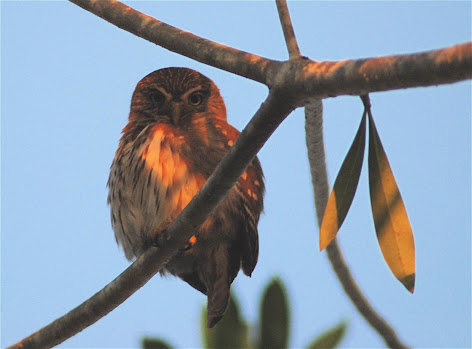
The next morning I woke up at 5:45 to grackles and a high hooting sound I couldn’t identify. So birder that I am, I got out of my very cozy bed, dressed, grabbed my binos off a shelf and went outside. I walked over to the sanitarios and met Nate. He said he wanted some toilet paper so I walked back to Poppi and grabbed the roll. As I was passing a tree next to our trailer I saw an unusual bump on a branch. I thought it was just a bump until I looked at it in my binos. Then I saw that it was actually an owl! I looked closer and saw that it was a pygmy-owl and either Northern or Ferruginous (I hoped it was Ferruginous because it is one of my favorite birds). Then Nate started calling to me to hurry up so I hustled the sanitary paper over to Nate (the owl still on my mind). Right after I had handed the paper to Nate I hurried to the tree and saw that the owl had moved to another tree on the other side of our pop-up. After I had located it I looked closely and then looked it up in my Howell and Webb Birds of Mexico and Northern Central America. Under range I found that Northern was in northern Mexico, Central American Pygmy-Owl was in the Chiapas rain forest, and Ferruginous was the only one on the Yucatan Peninsula. So it was pretty easy to figure out what species it was (Ferruginous). I was so excited because that was the bird I had first looked at in National Geographic’s Birds of North America that helped teach me to read when I was five!! It is also my 2nd favorite bird (second to Golden Eagle).
After I had admired the beautiful owl for a while I walked near the shore (we were in a lagoon) and saw a Spotted Sandpiper and some grackles bathing. I also saw a pair of Limpkins and Snail Kites! The Limpkins were wading out into the shallows and gulping down fish and the pair of kites were hunting snails near some reeds in shallow water. I jumped in the lagoon and swam as close to the kites as I could without disturbing them and watched them for a while; soaring, diving, and sometimes hovering above the water and picking off snails. It was a beautiful sight to watch (especially swimming 20 feet in front of them).
Oh, I almost forgot to describe the lagoon! Ok, the lagoon is actually more like a bay and is a popular place to swim in (especially at the campground) because it has clear blue water and has a sandy bottom. It is also a good birding spot-kites nest on little islands, cormorants rule the water, and there is plenty of waterfowl. Fair amounts of people (mostly extranjeros) have bought houses next to the lagoon and there are a couple of nice hotels. But the town is mostly about the lagoon and Cenote Azul (limestone hole filled with river water from 100-200 feet below the ground) across the road. We went there today (Monday) with Nate and Nichole and had great ceviche (kind of like pico de gallo but with shrimp, onions, and vinegar). Teslin and I also explored the cenote, which was about 70-100 feet deep. There were tons of fish including the big hunkers and little tiny minnows. We threw in tortillas and they all went bonkers! All the tortillas disappeared within 20 seconds and then they started looking at my leg! I quickly got out of the water before hungry fish ate me up!
Nate and Nichole are leaving tomorrow morning and are hitchhiking to Tulum, a beach town 220 mile from Bacalar. We are probably leaving tomorrow too (although we might stay here another night just for the swimming)!
After going to the ruins we headed back to our camper with Nate and Nichole (the couple), ate lunch, and put the trailer down. When we left for Bacalar it was about 3:30p.m. When we got to Bacalar it was sunset and we had to pop-up fast so that we wouldn’t be setting up in the dark. I didn’t see that many birds (they were probably already nestled up in their sleeping perches) so I helped set-up and then relaxed (ahhhhhh). We ate dinner at a spaghetti restaurant, which was pretty good in my opinion and had great limonada minerales. I had a pasta dish with spicy peppers and butter. After a delicious dinner we came back to Big Poppi and hit the sack.
The next morning I woke up at 5:45 to grackles and a high hooting sound I couldn’t identify. So birder that I am, I got out of my very cozy bed, dressed, grabbed my binos off a shelf and went outside. I walked over to the sanitarios and met Nate. He said he wanted some toilet paper so I walked back to Poppi and grabbed the roll. As I was passing a tree next to our trailer I saw an unusual bump on a branch. I thought it was just a bump until I looked at it in my binos. Then I saw that it was actually an owl! I looked closer and saw that it was a pygmy-owl and either Northern or Ferruginous (I hoped it was Ferruginous because it is one of my favorite birds). Then Nate started calling to me to hurry up so I hustled the sanitary paper over to Nate (the owl still on my mind). Right after I had handed the paper to Nate I hurried to the tree and saw that the owl had moved to another tree on the other side of our pop-up. After I had located it I looked closely and then looked it up in my Howell and Webb Birds of Mexico and Northern Central America. Under range I found that Northern was in northern Mexico, Central American Pygmy-Owl was in the Chiapas rain forest, and Ferruginous was the only one on the Yucatan Peninsula. So it was pretty easy to figure out what species it was (Ferruginous). I was so excited because that was the bird I had first looked at in National Geographic’s Birds of North America that helped teach me to read when I was five!! It is also my 2nd favorite bird (second to Golden Eagle).
After I had admired the beautiful owl for a while I walked near the shore (we were in a lagoon) and saw a Spotted Sandpiper and some grackles bathing. I also saw a pair of Limpkins and Snail Kites! The Limpkins were wading out into the shallows and gulping down fish and the pair of kites were hunting snails near some reeds in shallow water. I jumped in the lagoon and swam as close to the kites as I could without disturbing them and watched them for a while; soaring, diving, and sometimes hovering above the water and picking off snails. It was a beautiful sight to watch (especially swimming 20 feet in front of them).
Oh, I almost forgot to describe the lagoon! Ok, the lagoon is actually more like a bay and is a popular place to swim in (especially at the campground) because it has clear blue water and has a sandy bottom. It is also a good birding spot-kites nest on little islands, cormorants rule the water, and there is plenty of waterfowl. Fair amounts of people (mostly extranjeros) have bought houses next to the lagoon and there are a couple of nice hotels. But the town is mostly about the lagoon and Cenote Azul (limestone hole filled with river water from 100-200 feet below the ground) across the road. We went there today (Monday) with Nate and Nichole and had great ceviche (kind of like pico de gallo but with shrimp, onions, and vinegar). Teslin and I also explored the cenote, which was about 70-100 feet deep. There were tons of fish including the big hunkers and little tiny minnows. We threw in tortillas and they all went bonkers! All the tortillas disappeared within 20 seconds and then they started looking at my leg! I quickly got out of the water before hungry fish ate me up!
Nate and Nichole are leaving tomorrow morning and are hitchhiking to Tulum, a beach town 220 mile from Bacalar. We are probably leaving tomorrow too (although we might stay here another night just for the swimming)!
Mar 26, 2008
Euphonias and Honeycreepers and Tanagers, oh my!
March 20, 2008
This report is about the 2 places in the Mexican state of Chiapas, Palenque and Bonampak. The 2 locations are some of the best birding spots I’ve been to on our trip. Both spots have a huge diversity of pajáros including honeycreepers, euphonias, tanagers, toucans, parrots, hawks, and lots more. I have had a great time exploring around Bonampak and Palenque with our friends from Oaxaca, Esteban and Susan.
Palenque is famous for its Mayan ruins and jungle. Most people go to Palenque for the ruins but some people (like me for instance) go for Howler Monkeys, birds and other fauna. Palenque is in the state of Chiapas, in the southeastern jungle next to the border with Guatemala. That is partly why there are so many different species of birds and mammals. I didn’t see too many mammals, but Sue and I did see some large animals lumbering around in the brush just out of view. We could hear Howler Monkeys in the distance and saw them across the road from where we were camping. The Groove-billed Anis also made a racket in the underbrush and were almost as loud as the lizards and other beasts! There are also lots of interesting flora, butterflies, and insects.
On our first night in Palenque, Sue showed me the birds around the campground we were staying at (the Mayabell hotel). I was amazed how many birds there were just in the campground! Right at Sue’s camper we saw Red-capped Manakins, Black-headed Trogons, Yellow-winged Tanagers, Red-legged Honeycreepers, as well as Long-tailed Hermits, and Violet Sabrewings (hummingbirds). Each morning the Brown Jays woke me up at five-thirty and wouldn’t stop making a racket until evening! They were probably the noisiest birds in the place and the most annoying! They mimicked parrots and other birds so that it was confusing to figure out which was a Brown Jay and what was another bird!
Other then birds, Palenque has an interesting history. The area had its first inhabitants around 100 B.C. and it flourished from 600 to 700 A.D. One of the most famous rulers of the area was Pakal. The city grew under Pakal and stayed strong for a long time. During Pakal’s time, many plazas and other buildings were built, including Pakal’s own mausoleum. Most of the buildings from 600 A.D. are still intact and you can look at them in town (I didn’t) or go to the old ruins in the jungle. Palenque is also a great birding spot. On any given day, you could probably record more then 25 species and a lot of endemics. I saw 19 life birds in Palenque and 22 species in all. Overall, in Bonampak I saw more species then in Palenque.
Like Palenque, Bonampak is an ancient town (although, not as old as Palenque) and has a Mayan history. Outsiders did not discover Bonampak until 1946 (not including the Mayans who lived there) because the town lay in the middle of the jungle and not many people wanted to venture into the unknown forest (I probably would have risked it and explored the rain forest). The ruins there are very interesting (I went myself) and have good birds too. We (me, dad, mom, Teslin, and our friends Steve and Susan) walked up the steps to the top of the ruins and Susan and I birded around the top area. We didn’t see much there so we all went on a hike off a plane airstrip and I saw tons of new birds on that walk. Of the birds I saw, my favorite was the noisy Barred Antshrikes who wiggled their whole body when they called and made a weird noise at the end like a whining baby! I also saw Yellow-bellied Elaenia, Grey-collared Becard, Sulphur-rumped Flycatcher, and several other new birds.
There is also great birding on the road next to the campground we are staying at. Susan and I go out almost every morning on the road and we have had together, more than 30 new birds! For instance, this morning we went out and saw 4 new birds, the Great Antshrike (in Spanish, Batará Grande), Grey-breasted Martin (Martín Pechigrís), Smoky-brown Woodpecker (Carpintero Café), and a Bananaquit (Platanero; Reinita Mielera)! I also saw a migrant: a Blue-winged Warbler (Chipe Aliazul). In all, I have seen 78 species in Bonampak and about 30 life birds!!!
And for people who don’t have the faintest idea what I’m talking about, I just wrote: good-bye my friends, see you later, I am still a birder.
Cassidy
This report is about the 2 places in the Mexican state of Chiapas, Palenque and Bonampak. The 2 locations are some of the best birding spots I’ve been to on our trip. Both spots have a huge diversity of pajáros including honeycreepers, euphonias, tanagers, toucans, parrots, hawks, and lots more. I have had a great time exploring around Bonampak and Palenque with our friends from Oaxaca, Esteban and Susan.
Palenque
Palenque is famous for its Mayan ruins and jungle. Most people go to Palenque for the ruins but some people (like me for instance) go for Howler Monkeys, birds and other fauna. Palenque is in the state of Chiapas, in the southeastern jungle next to the border with Guatemala. That is partly why there are so many different species of birds and mammals. I didn’t see too many mammals, but Sue and I did see some large animals lumbering around in the brush just out of view. We could hear Howler Monkeys in the distance and saw them across the road from where we were camping. The Groove-billed Anis also made a racket in the underbrush and were almost as loud as the lizards and other beasts! There are also lots of interesting flora, butterflies, and insects.
On our first night in Palenque, Sue showed me the birds around the campground we were staying at (the Mayabell hotel). I was amazed how many birds there were just in the campground! Right at Sue’s camper we saw Red-capped Manakins, Black-headed Trogons, Yellow-winged Tanagers, Red-legged Honeycreepers, as well as Long-tailed Hermits, and Violet Sabrewings (hummingbirds). Each morning the Brown Jays woke me up at five-thirty and wouldn’t stop making a racket until evening! They were probably the noisiest birds in the place and the most annoying! They mimicked parrots and other birds so that it was confusing to figure out which was a Brown Jay and what was another bird!
Other then birds, Palenque has an interesting history. The area had its first inhabitants around 100 B.C. and it flourished from 600 to 700 A.D. One of the most famous rulers of the area was Pakal. The city grew under Pakal and stayed strong for a long time. During Pakal’s time, many plazas and other buildings were built, including Pakal’s own mausoleum. Most of the buildings from 600 A.D. are still intact and you can look at them in town (I didn’t) or go to the old ruins in the jungle. Palenque is also a great birding spot. On any given day, you could probably record more then 25 species and a lot of endemics. I saw 19 life birds in Palenque and 22 species in all. Overall, in Bonampak I saw more species then in Palenque.
Bonampak
Like Palenque, Bonampak is an ancient town (although, not as old as Palenque) and has a Mayan history. Outsiders did not discover Bonampak until 1946 (not including the Mayans who lived there) because the town lay in the middle of the jungle and not many people wanted to venture into the unknown forest (I probably would have risked it and explored the rain forest). The ruins there are very interesting (I went myself) and have good birds too. We (me, dad, mom, Teslin, and our friends Steve and Susan) walked up the steps to the top of the ruins and Susan and I birded around the top area. We didn’t see much there so we all went on a hike off a plane airstrip and I saw tons of new birds on that walk. Of the birds I saw, my favorite was the noisy Barred Antshrikes who wiggled their whole body when they called and made a weird noise at the end like a whining baby! I also saw Yellow-bellied Elaenia, Grey-collared Becard, Sulphur-rumped Flycatcher, and several other new birds.
There is also great birding on the road next to the campground we are staying at. Susan and I go out almost every morning on the road and we have had together, more than 30 new birds! For instance, this morning we went out and saw 4 new birds, the Great Antshrike (in Spanish, Batará Grande), Grey-breasted Martin (Martín Pechigrís), Smoky-brown Woodpecker (Carpintero Café), and a Bananaquit (Platanero; Reinita Mielera)! I also saw a migrant: a Blue-winged Warbler (Chipe Aliazul). In all, I have seen 78 species in Bonampak and about 30 life birds!!!
¡Adiós mis amigos!
¡Hasta luego!
¡Todavía soy pajarísto!
And for people who don’t have the faintest idea what I’m talking about, I just wrote: good-bye my friends, see you later, I am still a birder.
Cassidy
Mar 14, 2008
Birding at the Tuxtla Gutiérrez Zoológica


We went to the Tuxtla zoo on Tuesday. Actually it was more of a preserve then a zoo. I saw lots of birds and 2 life birds! I saw lots of Guans and Curassows walking around the zoo everywhere! They were very tame and you could walk within 5 yards of one and the darn bird wouldn't move! They also tried to rob your dinner plate! Especially the Plain Chachalacas. They would jump up on your table and then wait until you started eating and then you had to watch out! If you didn't pay enough attention to the birds under your table they'd walk right next to your chair and start begging for tacos!
There were also Motmots (we saw 1 next to the path), and these little weird creatures called Agoutis. Agoutis are rodents that look like miniature Capybaras. They seemed to fancy bananas and were sitting on their hind feet devouring bananas! Of course there were some caged animals like jaguars and warthogs in large natural enclosures, and a big aviary. In the aviary there were lots of colorful birds like Crimson-collared Grosbeak, Yellow-winged Cacique, and 2 very noisy Double-striped Thick-knees that stood on the path and shrieked as loud as they could! They got annoying after a while so we (my dad and I) left the aviary and went around the rest of the zoo in search of a Crested Guan. It took us a while to find one but at last we saw one, although it wasn't how we expected to see one. We rounded a bend in the path and saw a guan being chased by Agoutis! Boy, it was a funny sight; the guan running as fast as it's legs would carry it and the 2 Agoutis right on its tail! The guan eventually grew tired and flew up into a tree and was left in peace. My dad and I admired it for awhile and then moved on to look at other parts of the zoo.
There was a whole area of big enclosures for Birds of Prey from around the Chiapas area. Black Vultures perched on top of the cages looking bored and very hungry. Besides Crested Caracaras and Grey Hawks, they had a Collared Forest Falcon and a King Vulture. The vultures continued to look very hungry and were moving over the Caracara cage. The male or female Caracara (I think it was the male) brought over a piece of meat from the edge of their enclosure and started eating it with the female/male. The vultures didn't miss any of it. A group of about 5 birds came right up to the edge of the cage and tried to steal the caracara's precious piece of meat. Unfortunately for the vultures, the two hawks didn't miss anything either. The moment the vultures got too close he quickly jumped off their little branch, ran to the other side of the enclosure and buried the piece of meat in the ground at the foot of a tree. Then he came back and groomed the female.
Of all the animals in the zoo my favorite were the Spider Monkeys. The people who work at the zoo had put up a big enclosure with tall trees for the monkeys and the monkeys seemed very happy. My favorite was a young monkey who was very feisty and goal was to annoy all the adults and make the limbs of trees fall off! I stayed at the primate cage for a long time and only left when my dad said he had seen a guan on the path. Later, as we were walking through the zoo I saw some movement in the treetops and thought that a vulture had landed in the top. I was wrong. A monkey seemed to have escaped from it's enclosure and was happily swinging in the trees making a huge commotion as it passed. I still wonder how it got out of it's enclosure but I can only guess. I think it might have somehow swung from a tree in the enclosure to another tree on the other side of the fence. Then it probably swung around the zoo, scaring all the birds in the vicinity away as it went!
Besides the birds I have already mentioned, I also saw a flock of Green Jays, 1 Bare-throated Tiger Heron, a Brown Pelican, White Ibises, White-winged Doves, 1 Russet-crowned Motmot, the ever present House Sparrow, Great-tailed Grackle and a dove species I couldn't identify.
I also saw lots of birds that were in enclosures including Scarlet Macaws, Keel-billed Toucan, Green Parakeets and numerous types of chachalacas.
There was also a jaguar who roared very loudly as we were leaving and made the hair on the back of my neck stand on end. We were planning on going to a forested canyon nearby called Sumidero Canyon but we didn't have time. Instead we decided to head back to our pop-op trailer that was waiting for us at home in Ocozocoatla at Hogar Infantil. On the way to Ocozocoatla I saw a flock of White-fronted Parrots by the road! I only got a quick look at them though and I was a little disappointed. But it was the first parrot I had ever seen so I am pretty contented (for the moment).
When we got home we all had a quick dinner (hot dogs and noodles), brushed our teeth and all went to bed. That night I dreamed of curassows, guans, and chachalacas all chasing me into a pool. It must have been from seeing so many of them and taking pictures. Then I think they wanted revenge! Uh-oh, gotta run! Keep watch for curassows!
Mar 13, 2008
Llano Grande Bird Walk-March 4th 2008
Llano Grande March 4th 2008
We (the Ruges) took a hike in Llano Grande with some friends of ours-Courtney, Jake, and Jake’s mom and dad, Jan and Marty. It was a 14 km hike (8-9 miles) with a guide from Llano Grande named Jose. It was a great hike! We started off in pine forest at around 10,000 feet and ended up at about 10,500 feet in mixed pine forest.
There was pretty good birding along the hike. We saw about 13 species including Bushtits, Mexican Chickadees, Warbler, Slate-throated Redstart, Red, Cresent-chested and Hermit Warblers, Turkey Vulture, Red-tailed Hawks, Steller’s Jays, Yellow-eyed Juncos, and Common Raven. And best of all I lured in a Mountain Trogon with my iPod and Jake and Courtney’s speaker! Jose heard the trogon calling and told it to all of us. I whipped out my iPod and played the call of the Mountain Trogon. A male came almost instantly. First, it flew right next to the trail and then flew over us to another tree on the other side of the trail. We all got great looks at it as it showed off to us and donned its black and white outer tail feathers. That trogon was the first trogon I had ever seen-it was all very exciting!!!
We hiked to a peak and looked for raptors but there wasn’t many. On the way down we saw more warblers and heard the mountain trogon. We were all very tired when we got back to our little cabanas (cabins) and we all took a long siesta. The cabins were pretty small but comfy and we all liked our little haven a lot. Jake, Courtney, and Jake’s mom and dad were staying right across from us (Ruges) in a 2 room cabin. I was pretty sore from the 6 hour hike (I threw out my back) and Jan (Jake’s mom) gave me some arnica and an aspirin-like liquid. We ate dinner at a restaurant with trout. It was delicious! We even got to watch the owners of the place catch the trout! There was a little concrete pool filled with about 15 trout that they got the trout from. They also had great quesadillas filled with Oaxacan string cheese. Tasty! It was the best meal I had had in a long time.
The next day we all packed up and headed back to Oaxaca to our posadas in separate cars.
Jan 15, 2008
Bird List: July 2007-July 2008
Bird Nut’s birding year
By Cassidy Ruge, age 13
By Cassidy Ruge, age 13
Cassidy’s Trip: My family and I are on a trip around the US, Canada, and Mexico and are staying in a camper and sometimes tents. We traveled from Massachusetts to Iowa, then all the way up to Alaska and did a lot of birding there and then headed south through British Columbia, Yellowstone Nat. Park and then followed the Rockies all the way down to Tucson. After a month in Arizona, we are going to Mexico all the way down to the Yucatan Peninsula and Chiapas. We are even thinking of going all the way to Costa Rica and doing the great birding areas there.
My Birding Year: I am keeping track of birds I see, but it is not an official “Big Year” according to the ABA. I have seen a ton of birds (A list of the species I saw is below). I probably couldn’t count all the species but I’ll try to do it below.
Massachusetts to Alaska to Tucson
1. Snow Goose
2. Snow Goose (blue form)
3. Canada Goose
4. Trumpeter Swan (new=life bird)
5. Tundra Swan (new)
6. Gadwall
7. American Wigeon
8. American Black Duck
9. Mallard
10. Blue-winged Teal
11. Cinnamon Teal (new)
12. Northern Shoveler
13. Northern Pintail
14. Green-winged Teal
15. Redhead
16. Canvasback
17. Lesser Scaup
18. Harlequin Duck
19. Surf Scoter
20. White-winged Scoter
21. Black Scoter
22. Common Goldeneye
23. Common Merganser
24. Ruddy Duck
25. Ring-necked Pheasant
26. Ruffed Grouse
27. Spruce Grouse (new)
28. Spruce Grouse (“Franklin’s Grouse”) (new)
29. Willow Ptarmigan (new)
30. Sharp-tailed Grouse (new)
31. Wild Turkey
32. Gambel’s Quail
33. Pacific Loon (new)
34. Common Loon
35. Pied-billed Grebe
36. Red-necked Grebe
37. Eared Grebe
38. Cory’s Shearwater
39. Greater Shearwater
40. Sooty Shearwater
41. Manx Shearwater (new)
42. Wilson’s Storm-Petrel
43. American White Pelican
44. Brandt’s Cormorant (new)
45. Double-crested Cormorant
46. Pelagic Cormorant (new)
47. Red-faced Cormorant (new)
48. Great Blue Heron
49. Black Vulture
40. Turkey Vulture
51. Osprey
52. Bald Eagle
53. Northern Harrier
54. Sharp-shinned Hawk
55. Cooper’s Hawk
56. Northern Goshawk
57. Red-tailed Hawk
58. Red-tailed (Harlan’s Hawk) (new)
59. Rough-legged Hawk
60. Golden Eagle (new)
61. American Kestrel
62. Prairie Falcon (new)...Aplomado Falcon (not a countable bird according to the ABA because it doesn't have a sustainable population)
63. American Coot
64. Sandhill Crane
65. Killdeer
66. Black Oystercatcher (new)
67. Greater Yellowlegs
68. Lesser Yellowlegs
69. Wandering Tattler (new)
70. Upland Sandpiper (new)
71. Black Turnstone (new)
72. Surfbird (new)
73. Dunlin
74. Long-billed Dowitcher
75. Wilson’s Phalarope
76. Red-necked Phalarope
77. Laughing Gull
78. Heermann’s Gull (new)
79. Mew Gull (new)
80. Ring-billed Gull
81. Herring Gull
82. Glaucous-winged Gull (new)
83. Glaucous Gull
84. Great Black-backed Gull
85. Black-legged Kittiwake (new)
86. Common Tern
87. Black Tern (new)
88. Common Murre (new)
89. Pigeon Guillemot (new)
90. Marbled Murrelet (new)
91. Kittlitz’s Murrelet (new)
92. Rhinoceros Auklet (new)
93. Horned Puffin (new)
94. Tufted Puffin (new)
95. Rock Pigeon
96. Eurasian Collard-Dove (new)
97. White-winged Dove (new)
98. Morning Dove
99. Inca Dove
100. Greater Roadrunner
101. Great Horned Owl
102. Common Nighthawk
103. Ruby-throated Hummingbird
104. Belted Kingfisher
105. Red-headed Woodpecker
106. Acorn Woodpecker
107. Gila Woodpecker
108. Red-bellied Woodpecker
109. Downy Woodpecker
110. Hairy Woodpecker
111. Northern Flicker (Yellow-Shafted)
112. Northern Flicker (Red-Shafted) (new)
113. Western Wood-Peewee (new)
114. Eastern Phoebe
115. Black Phoebe
116. Say's Phoebe (new)
117. Great Crested Flycatcher
118. Western Kingbird (new)
119. Eastern Kingbird
120. Loggerhead Shrike
121. Red-eyed Vireo
122. Gray Jay (new)
123. Steller’s Jay
124. Blue Jay
125. Western Scrub-Jay (new)
126. Clark’s Nutcracker (new)
127. Black-billed Magpie
128. American Crow
129. Northwestern Crow (new)
130. Fish Crow
131. Common Raven
132. Horned Lark
133. Purple Martin
134. Tree Swallow
135. Cliff Swallow
136. Barn Swallow
137. Black-capped Chickadee
138. Mountain Chickadee
139. Chestnut-backed Chickadee (new)
140. Boreal Chickadee (new)
141. Tufted Titmouse
142. Red-breasted Nuthatch
143. Pygmy Nuthatch (new)
144. Rock Wren (new)
145. House Wren
146. Sedge Wren (new)
147. Marsh Wren
148. Winter Wren
149. American Dipper (new)
150. Eastern Bluebird
151. Mountain Bluebird
152. Townsend’s Solitaire (new)
153. Swainson’s Thrush (new)
154. Varied Thrush
155. Gray Catbird
156. Northern Mockingbird
157. Brown Thrasher
158. European Starling
159. American Pipit
160. Cedar Waxwing
161. Phainopepla
162. Orange-crowned Warbler (new)
163. Yellow Warbler
164. Townsend’s Warbler (new)
165. Scarlet Tanager
166. Brewer’s Sparrow (new)
167. Lark Sparrow (new)
168. Fox Sparrow
169. Song Sparrow
170. Golden-crowned Sparrow (new)
171. Dark-eyed Junco (Slate-colored)
172. Dark-eyed Junco (Oregon)
173. Bobolink
174. Red-winged Blackbird
175. Western Meadowlark (new)
176. Common Grackle
177. Baltimore Oriole
178. White-winged Crossbill (new)
179. American Goldfinch
180. House Sparrow
Arizona to Mexico
Tucson to Madera Canyon
181. Rufous-crowned Sparrow (new)
182. White-breasted Nuthatch
183. Mexican Jay (new)
184. Black-chinned Sparrow (new)
Madera Canyon to Sonoita Creek Preserve
185. Abert’s Towhee (new)
186. Inca Dove
Sonoita to Ash Canyon
187. Arizona Woodpecker (new)
188. Ladder-backed Woodpecker (new)
189. Scott’s Oriole (new)
190. Painted Redstart (new)
191. Hammond’s Flycatcher (new)
192. Yellow-rumped Warbler (Audubon’s) (new)
193. Red-naped Sapsucker (new)
194. Canyon Towhee (new)
195. House Finch
196. Lesser Goldfinch
197. Pine Siskin
198. Pyrrhuloxia
199. Yellow-eyed Junco (new)
Ash Canyon to Patagonia
200. Common Moorhen
201. Anna’s Hummingbird (new)
Patagonia to Tucson
202. Chihuahuan Raven (new)
203. Great-tailed Grackle
204. Black-throated Sparrow
Tucson to Arivaca, AZ
205. Montezuma Quail (new)
Tucson
206. Costa’s Hummingbird (new)
Sabino Canyon
207. White-throated Swift (new)
208. Cactus Wren
Tucson to McAllen, Texas
209. Golden-fronted Woodpecker (new)
210. Common Ground-Dove (new)
211. Crested Caracara (new)
212. Harris’s Hawk (new)
McAllen to Santa Ana NWR, Donna TX.
213. Plain Chachalaca
214. Great Kiskadee
215. Black-crested Titmouse (new)
216. Green Jay (new)
217. Olive Sparrow (new)
Donna to Mission, TX (Americana RV Park)
218. Buff-bellied Hummingbird (new)
219. Long-billed Thrasher (new)
Mission Texas to Ciudad Victoria, Mexico
220. Vermilion Flycatcher (new)
Ciudad Victoria to Nautla, Mexico
221. White-tailed Hawk (new)
222. Blue-Gray Tanager*new (*= Mexican Endemic)
223. Sanderling
224. Yellow-throated Warbler (new)
225. Blackburnian Warbler
Nautla to Oaxaca, Mexico
226. Tropical Kingbird (new)
227. White-collared Swift*new
Oaxaca
228. Wilson’s Warbler
229. Nashville Warbler (at last!)
230. Yellow Grosbeak (new)
231. Gray Silky-Flycatcher*new
232. Orchard Oriole
233. Bridled Sparrow*new
234. Berylline Hummingbird (new)
235. Summer Tanager (new)
236. Dusky Hummingbird*new
237. White-throated Towhee*new
Teotitlan del Valle, Oaxaca
238. Grey-breasted Woodpecker*new
239. Nutting’s Flycatcher*new
240. Boucard’s Wren*new
241. Clay-colored Sparrow (new)
242. Virginia’s Warbler (new)
243. Blue Grosbeak (new)
244. Grasshopper Sparrow (new)
245. Black-vented Oriole*new
246. Black-throated Grey Warbler (new)
247. Sora (new)
248. Western Tanager (new)
Teotitlan Dam
249. Least Grebe (new)
250. Violet Green Swallow (new)
251. Northern Rough-winged Swallow
Teotitlan to Benito Juarez (Neveria Trail), Oaxaca
252. Short-tailed Hawk (new)
253. Zone-tailed Hawk (new)
254. Chestnut-sided Shrike-Vireo*new
255. Red Warbler*new
256. Grey-barred Wren*new
257. Grey-breasted Wood-Wren*new
258. Slate-throated Redstart*new
259. Black-headed Grosbeak (new)
260. Hepatic Tanager (new)
261. Spot-crowned Wooodcreeper*new
262. Hermit Warbler (new)
263. Hutton’s Vireo (new)
264. White-throated Robin*new
265. Blue-headed Vireo
266. Olive-sided Flycatcher (new)
267. Magnificent Hummingbird (new)
268. White-eared Hummingbird (new)
269. Band-tailed Pigeon*new
Benito Juarez to Oaxaca City (Instituto Cultural)
270. Rufous-backed Robin*new
Instituto Cultural to Posada del Fortin
271. Bronzed Cowbird (new)
272. Clay-colored Robin*new
Posada del Fortin to Llano Grande, Oaxaca
273. Mexican Chickadee (new)
274. Bushtit “Black-eared”new
275. Mountain Trogon*new
Posada del Fortin to Tehuantepec, Oaxaca
279. Russet-crowned Motmot*new
280. Yellow-winged Cacique*
281. Scissor-tailed Flycatcher (new)
282. White-throated Magpie Jay*new
Tehauntepec to Ocozocoatla and Tuxtla Gutierrez, Chiapas
283. Scrub Euphonia*new
284. Bat Falcon*new
285. Buff-collared Nightjar*new
286. White-lored Gnatcatcher*new
287. Black-headed Saltator*new
288. Great Curassow*new
289. Crested Guan*new
290. Bare-throated Tiger Heron*
291. White Ibis
292. White-fronted Parrot*new
Ocozocoatla to San Cristóbal, Chiapas
293. Rufous-collared Sparrow*new
San Cristóbal to Palenque, Chiapas
294. Montezuma Oropendola*new
295. White-crowned Parrot*new
296. Buff-throated Saltator*new
297. Brown Jay*new
298. Rufous-tailed Hummingbird*new
299. Red-lored Parrot*new
300. Yellow-winged Tanager*new
301. Keel-billed Toucan*new
302. Melodious Blackbird*new
303. White Hawk*new
Palenque
304. Black-headed Trogon*new
305. Red-capped Manakin*new
306. Great Black-Hawk*
307. Long-billed Hermit*new
308. Violet Sabrewing*new
309. Wood Thrush
310. Grey Catbird
311. Golden-hooded Tanager*new
312. Red-legged Honeycreeper*new
313. Collared Aracari*new
314. Yellow-throated Euphonia*new
315. Roadside Hawk*new
Palenque to Bonampak, Chiapas
316. Northern Jacana*
Bonampak
317. Scaled Pigeon*new
318. Pauraque (new)
319. Violaceous Trogon*new
320. Black-cheeked Woodpecker*new
321. Black-crowned Tityra*new
322. Crimson-collared Tanager*new
323. Scarlet-rumped Tanager*new
324. Rufous-tailed Jacamar*new
325. Barred Antshrike*new
326. Chestnut-colored Woodpecker*new
327. Grey-collared Becard*new
328. Spot-breasted Wren*new
329. Sulphur-rumped Flycatcher*new
330. Hooded Warbler
331. Black-faced Grosbeak*new
332. Olive-backed Euphonia*new
Bonampak
333. Tropical Pewee*new
334. Band-backed Wren*new
335. Plain Xenops*new
336. Blue Ground-Dove*new
337. Lineated Woodpecker*new
338. Chestnut-headed Oropendola*new
339. Ruddy Ground-Dove (new)
340. SCARLET MACAW*new!!!
341. Golden-olive Woodpecker*new
342. Bright-rumped Attila*new
343. Thick-billed Seed-Finch*new
344. Little Hermit*new
345. Dot-winged Antwren*new
346. Rufous Piha*new
347. Rufous Mourner*new
348. Yellow-bellied Elaenia*new
349. Smoky-brown Woodpecker*new
350. Great Antshrike*new
351. Grey-breasted Martin*new
352. Blue-winged Warbler
353. Bananaquit (new)
Bonampak to Yaxchilán, Chiapas
354. Blue-crowned Motmot*new
355. Royal Flycatcher*new
356. Swallow-tailed Kite (new)!!!
Yaxchilán to Bonampak
357. Scaly-breasted Hummingbird*new
358. White-bellied Emerald*new
359. White-eyed Vireo
360. Mangrove Swallow*new
361. Black-necked Stilt
362. Rose-breasted Grosbeak
363. Social Flycatcher*
364. Dusky-capped Flycatcher (new)
365. Canyon Wren
366. Ivory-billed Woodcreeper*new
367. Snowy Egret
368. Neotropic Cormorant
369. Reddish Egret
370. Canada Warbler (new)
371. N. Rough-winged Swallow
372. Belted Flycatcher*new
Bonampak to Palenque
373. Kentucky Warbler (new)
374. Amethyst-throated Hummingbird*new
375. Broad-winged Hawk (migrating)
376. Common Black Hawk
377. Collared Trogon*new
378. Rufous-breasted Spinetail*new
Palenque to Campeche, Quintana Roo
379. Black-bellied Whistling-Duck (new)
380. Black-collared Hawk*new
Campeche to Calakmul ruins, QR
381. Ocellated Turkey*new
382. Pale-billed Woodpecker*new
383. Olivaceous Woodcreeper*new
384. Lesser Greenlet*new
385. Magnolia Warbler
Calakmul to Bacalar, QR
386. Snail Kite
387. Limpkin
388. Ferruginous Pygmy-Owl!!! (new)
389. Green Heron
390. Red-billed Pigeon*new
Bacalar to Felipe Carrio Puerto, QR
391. Tropical Mockingbird*new
Felipe Carrio Puerto (Vigia Chico Rd)
392. Hook-billed Kite
393. Aztec Parakeet*new
394. Thrush-like Mourner*new
395. Yucatan Jay*new
396. Black-cowled Oriole*new
Felipe Carrio Puerto to Paa Mul, QR
397. Brown-crested Flycatcher (new)
398. Grey-necked Wood-Rail*new
399. Yucatan Flycatcher*new
400. Sulphur-bellied Flycatcher (new)
Paa Mul to Dr. Alfredo Barrea M. Garden (near Cancun)
401. Black-throated Green Warbler
Dr. Alfredo Garden to Rio Lagartos, Yucatan
402. Sandwich Tern (new)
403. Black Skimmer (new)
404. Royal Tern (new)
405. Gull-billed Tern (new)
406. Greater Flamingo (new)
407. Laughing Falcon*new
408. Western Sandpiper (new)
Rio Lagartos to Hacienda Ticuch, Valladolid
409. Yellow-green Vireo (new)
410. Couch’s Kingbird (new)
411. Yellow-faced Grassquit*new
Hacienda Ticuch to Mayaland Hotel, Yucatan
412. Grayish Saltator*new
413. Rose-throated Becard (new)
414. Yucatan Woodpecker*new
415. Turquoise-browed Motmot*new
Mayaland hotel to Chichén Itzá ruins, Yucatan
416. Greenish Elaenia*new
417. Orange Oriole*new
Chichén Itzá to Isla Aguada, Campeche
***Yucatan Parrot (not countable-in cage)
Isla Aguada to Catemaco, Veracruz
418. Green-breasted Mango*new
419. Boat-billed Flycatcher*new
420. White-breasted Wood-Wren*new
Catemaco to San Miguel de Allende, Guanajuato
San Miguel de Allende to Saltillo, Coahula
Saltillo to Del Rio, Texas
Del Rio to Fort Davis, Texas (Prude Ranch)
421. Dark-eyed Junco “Gray-headed” (new)
422. Elf Owl (new) (nesting pair in phone poll)
Prude Ranch to Tucson (Milagro Co-housing)
423. Ash-throated Flycatcher (new)
Milagro to Sweetwater Wetlands
424. Black-crowned Night-Heron (new)
Sweetwater to Milagro
Milagro to Las Vegas, New Mexico
425. Swainson's Hawk (new)
426. Lewis's Woodpecker (new)
427. Black-chinned Hummingbird
428. Juniper Titmouse (new)
Las Vegas to Carson Natl. Forest, NM
429. Broad-tailed Hummingbird (new)
Carson Natl. Forest to Las Vegas
Las Vegas to Santa Fe, New Mexico
430. Cassin's Finch (new)
431. Cordilleran Flycatcher (new)
Santa Fe to Las Vegas
Las Vegas to Cape Cod-Chatham Inlet
432. American Oystercatcher*new
Orleans, Massachusettts to South Cape Beach-Mashpee
433. Saltmarsh Sharp-tailed Sparrow*new
Orleans to Las Vegas, New Mexico
Clinton, Oklahoma
434. Mississippi Kite*new
Clinton to Las Vegas
Las Vegas to Ruby Ranch, NM
435. Sabine's Gull*new
436. Lark Bunting*new
437. Western Grebe*new
438. Clark's Grebe*new
Subscribe to:
Posts (Atom)
Home in New Mexico!

Las Vegas
Common Black Hawk
Rio Lagartos, Yucatan
Ferruginous Pygmy-Owl
Bacalar
Pale-billed Woodpecker

Kalakmul ruins
Dark-eyed Junco

Home
Red-tailed Hawk

In my backyard-Las Vegas,NM
Me on Hermit's Peak
Las Vegas, New Mexico
Zia Being Cute

Home